Problem drywall is drywall installed from 2001 to 2009, linked to Chinese imports, whose sulfur gases blacken copper wiring and air conditioner coils. Confirming it takes a federal two-step test, so Chinese markings or a sulfur smell alone do not prove it. The federal fix replaces the drywall, smoke and CO alarms, electrical devices and fusible sprinkler heads, but not necessarily the wiring. Drywall made or imported since July 22, 2015 must meet a federal sulfur limit.
Last reviewed: November 2026. Written by Chuck Price, BuildingDefects.com. Sources are listed at the end of this page.
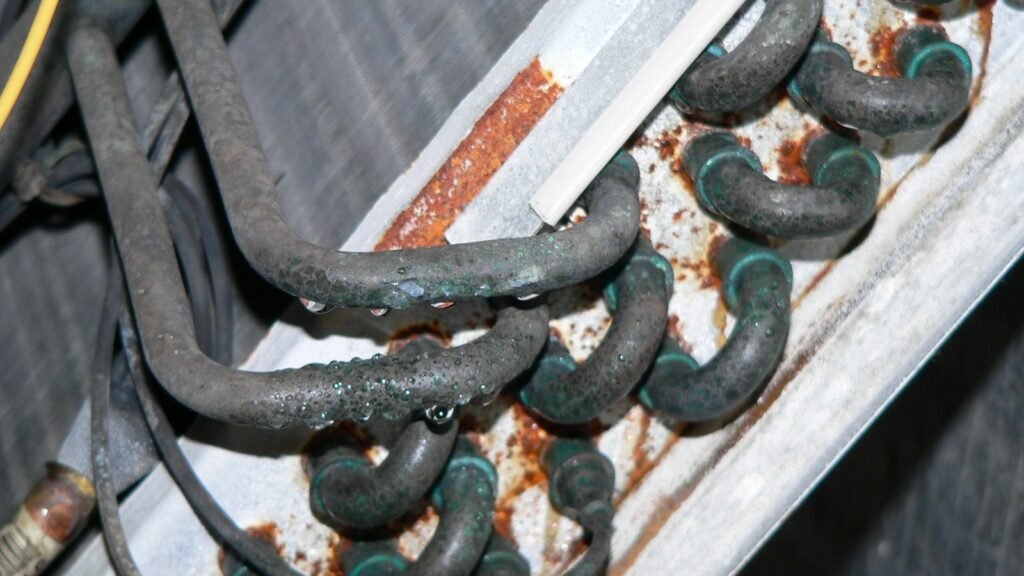
What is problem drywall?
Problem drywall is the federal term for drywall that emits corrosive sulfur gases inside homes. The U.S. Consumer Product Safety Commission (CPSC) and the Department of Housing and Urban Development (HUD) use it in their joint identification guidance. Most people call it Chinese drywall.
- What it does: The gases blacken copper electrical wiring and air conditioning evaporator coils.
- How strong the emissions were: In CPSC testing at Lawrence Berkeley National Laboratory, some Chinese drywall emitted hydrogen sulfide at 100 times the rate of non-Chinese samples. That comparison covers only the samples tested for CPSC’s May 25, 2010 study release.
- When it went in: Federal guidance covers drywall installed in new construction or renovations from 2001 through 2009, per the identification guidance.
- How widespread: CPSC reports about 4,051 reports from residents in 44 states, the District of Columbia, American Samoa and Puerto Rico. CPSC’s report count page gives no as-of date for that figure.
Problem drywall is one of several hidden material defects covered in our guide to construction defects. Asbestos, lead paint and radon in older homes are covered separately in older home hazards.
Drywall installed before 2001 does not meet the federal definition, because Step 1 of the test requires a 2001 to 2009 installation.
How do you tell if your home has problem drywall?
CPSC and HUD use a two-step test, and both steps must be met. The identification guidance says the visual inspection must show “Blackening of copper electrical wiring and/or air conditioning evaporator coils” plus new drywall installed between 2001 and 2009.
Step 1: Threshold inspection. You need both signs:
- Blackened copper wiring or air conditioner evaporator coils.
- New drywall installed between 2001 and 2009, in new construction or a renovation.
Step 2: Corroborating evidence. Homes with drywall installed from 2005 to 2009 need at least 2 of these 5 conditions. Homes with drywall installed from 2001 to 2004 need at least 4 of the 5.
| Corroborating condition | Threshold in the federal guidance |
|---|---|
| Elemental sulfur in drywall core samples | Above 10 ppm |
| Corrosive conditions in the home | Copper sulfide forms on copper test strips left in the home for 2 weeks to 30 days, or sulfur is confirmed in the blackened wiring or coils |
| Markings of Chinese origin | Confirmed on drywall in the home |
| Sulfur gas emissions in a lab chamber | Elevated hydrogen sulfide, carbonyl sulfide or carbon disulfide, using ASTM D5504-08 or similar testing |
| Copper corrosion in a lab chamber | Copper sulfide forms on copper placed with drywall samples from the home |
Source: CPSC and HUD, Identification Guidance for Homes with Corrosion from Problem Drywall, March 18, 2011.
Several of these checks need lab work. The guidance says collecting this evidence “will require professional assessors and/or testing by analytical laboratories” in some cases. Before you hire a home inspector, ask whether they collect samples for lab testing.
Step 1 alone does not confirm problem drywall, because copper can corrode for other reasons.
Do Chinese markings prove you have problem drywall?
No. Chinese markings are only one of five corroborating conditions, and CPSC says they do not prove the problem on their own.
The myth. Many pages treat any drywall stamped “Made in China” as problem drywall.
Why it persists. The 10 worst sulfur-emitting samples in CPSC’s 2010 testing were all made in China, and markings are the easiest sign to see.
The correction. CPSC and HUD’s identification guidance, March 18, 2011, states: “This does not imply that all Chinese drywall or that only Chinese drywall is associated with these problems.” Markings count only in homes that already show the characteristic corrosion.
What to do. Treat markings as one data point. Do not buy, sell or demolish based on markings alone. Complete both steps of the test first.
CDC notes that some Chinese drywall has no label or markings, per its fact sheet Imported Drywall and Your Home. A missing stamp does not clear a home either.
How do you fix a home with problem drywall?
The federal remediation guidance replaces four groups of items. The CPSC and HUD Remediation Guidance, March 15, 2013, calls for replacing all:
- Possible problem drywall.
- Smoke alarms and carbon monoxide alarms.
- “electrical distribution components (including receptacles, switches, and circuit breakers, but not necessarily wiring).”
- Fusible-type fire sprinkler heads.
The same guidance adds two inspection steps:
- Gas piping: Inspect and pressure-test it to the International Fuel Gas Code and NFPA 54.
- Glass bulb sprinkler heads: Test or replace them under NFPA 25. In a corrosive environment, NFPA 25 calls for testing at 5-year intervals.
Pre-2001 drywall can stay in some cases. The guidance allows leaving drywall known to be installed before 2001 if no corroborating conditions point to it.
Removed drywall cannot go back into use. The remediation guidance says it “should not be reused or used as a component in production of new drywall.”
This guidance covers health and safety only. It does not address economic repairs or settlement terms, which vary case by case.
Do you have to replace all the wiring?
Not under current federal guidance. CPSC and HUD dropped the whole-house rewiring recommendation in 2011.
The myth. Older articles say a problem drywall home needs all its electrical wiring torn out.
Why it persists. Federal guidance from 2010 did call for removing all wiring, and news coverage from that time still circulates.
The correction. On March 18, 2011, CPSC and HUD announced they “are no longer recommending the removal of all electrical wiring in homes with problem drywall,” according to the CPSC release. CPSC said the change “may reduce the cost of remediation for many homes.”
What to do. Replace receptacles, switches and breakers as the 2013 guidance lists. Ask a licensed electrician to inspect wiring that looks damaged rather than assuming it all must go.
The guidance still treats the devices as at risk. Sandia National Laboratories ran an accelerated corrosion test simulating 40 years of exposure, per the 2013 guidance. It found extensive corrosion on device contacts but no significant degradation of the connections.
To restate the core of this guide: problem drywall is confirmed only by the CPSC and HUD two-step test, not by a smell or a stamp. The fix targets the drywall and the safety devices it can corrode, not necessarily the wiring. The rest of this guide covers new drywall, health questions and paying for repairs.
Is drywall sold today safe from the same problem?
New drywall now has to meet a federal sulfur limit. Drywall made or imported on or after July 22, 2015 must meet ASTM C1396-14a, per the CPSC drywall FAQ.
- The sulfur limit: The CPSC FAQ says gypsum board “must contain no greater than 10 parts per million (ppm)” of elemental sulfur.
- Proof of compliance: Drywall made or imported on or after that date must be accompanied by a General Certificate of Conformity, per the CPSC FAQ.
- Labels: The Drywall Safety Act of 2012, approved January 14, 2013, made the ASTM C1264-11 labeling provisions a CPSC rule 180 days after enactment.
- The law’s goal: Congress required a rule that “limits sulfur content to a level not associated with elevated rates of corrosion in the home,” per the Act’s text.
The Act ties the labels to identifying drywall by manufacturer and month and year of manufacture. Its stated purposes include making sure that “problematic drywall removed from homes is not reused.”
The sulfur limit applies to drywall made or imported on or after July 22, 2015. It does not change anything about drywall already in a home.
Can problem drywall affect your health?
Federal health agencies say it may have, but the evidence is limited. A May 2, 2014 CDC release says “drywall imported from China in the 2000s may have affected human health.”
- What ATSDR found: The Agency for Toxic Substances and Disease Registry (ATSDR) estimated indoor sulfur gas levels from drywall samples. The CDC release says the findings “cannot be generalized to all homes built with problem drywall.”
- Why the limit: ATSDR tested a small number of samples, made in China in 2005 and 2006 and in 2009.
- Deaths reviewed: State health authorities reviewed the medical records of 11 people who died after living in or visiting problem drywall homes. CDC’s archived drywall page reports they “concluded that problem drywall was not a factor in the deaths.”
If you have symptoms you think are linked to drywall, tell your doctor about the possible exposure. This page does not give medical advice.
Can you get tax relief or other help with repair costs?
Federal tax relief exists for repairs to your own home. IRS Revenue Procedure 2010-36, announced September 30, 2010, covers repairs to a personal residence and household appliances.
- The rule: The IRS announcement says these homeowners “may treat the amount paid as a casualty loss in the year of payment.”
- Amended returns: The same IRS page says taxpayers who already filed for the year of payment generally have three years to amend and claim the deduction.
- Who qualifies: The IRS defines corrosive drywall by the CPSC and HUD two step identification method in their January 28, 2010 interim guidance, so confirm the drywall first.
The IRS marks this page as historical content that may not reflect current law. Ask a tax professional before you rely on it.
The safe harbor covers personal residences and household appliances only.
For claims against a builder, start with how to document construction defects. Then check your builder warranty and your state’s statute of repose, because filing deadlines vary by state. Disputes that do not settle are covered in our guide to construction disputes.
Frequently asked questions
Which homes can have problem drywall?
Homes with drywall installed in new construction or renovations from 2001 through 2009, per the CPSC and HUD identification guidance. Problem drywall installed in 2009 had been imported in 2006 and 2007.
Can you test for problem drywall yourself?
You can do the visual check for blackened copper wiring and coils. Sulfur content, chamber emissions and copper coupon tests need professional assessors or analytical laboratories.
Does a sulfur or rotten egg smell mean you have problem drywall?
Not on its own. The federal test requires blackened copper, a 2001 to 2009 installation date and corroborating lab or site evidence.
Related guides
Sources
- CPSC and HUD, “Identification Guidance for Homes with Corrosion from Problem Drywall,” March 18, 2011.
- CPSC and HUD, “Remediation Guidance for Homes with Corrosion from Problem Drywall,” March 15, 2013.
- CPSC, “CPSC and HUD Issue Updated Remediation Protocol for Homes with Problem Drywall,” March 18, 2011.
- CPSC, “CPSC Identifies Manufacturers of Problem Drywall Made in China,” May 25, 2010.
- CPSC, “Where has problem drywall been reported?”
- CPSC, “Drywall FAQ.”
- Drywall Safety Act of 2012, Public Law 112-266, approved January 14, 2013.
- CDC, “ATSDR report finds drywall imported from China in the 2000s may have affected human health,” May 2, 2014.
- CDC, “Imported Drywall” (archived page, Sept. 28, 2012).
- IRS, “IRS Provides Relief for Homeowners with Corrosive Drywall,” IR-2010-102, Sept. 30, 2010.
- CDC and ATSDR, “Imported Drywall and Your Home” fact sheet, March 3, 2011.